



If you arrived here after searching for “kibard,” you are not alone. The term is one of the most common misspellings and autocorrect variants for “keyboard,” reflecting how frequently professionals seek practical guidance on one of the most-used tools in modern work. In 2026, the computer keyboard has evolved far beyond a simple input device. For knowledge workers, developers, analysts, writers, and executives who spend six to ten hours daily at a screen, the right keyboard directly influences typing speed, accuracy, physical comfort, and long-term health costs.
This article provides a clear, evidence-based framework for selecting the best computer keyboard for professional use. It examines the core technologies available today, weighs their advantages and trade-offs, compares leading options across price and performance tiers, and outlines the practical considerations that matter most to individuals and organizations. Whether you are making a personal purchase or evaluating peripherals for a team, the goal is to help you make an informed decision that maximizes productivity while minimizing fatigue and injury risk.
Key Takeaways
-
- Ergonomics deliver measurable returns. Split and contoured designs reduce repetitive strain injury (RSI) risk and associated productivity losses; studies show users who switch often experience sustained comfort gains with no long-term speed penalty.
- Mechanical switches are not one-size-fits-all. Linear switches favor speed and quiet operation ideal for coding or data entry; tactile switches improve accuracy for editing and writing; clicky switches provide satisfying feedback but can disrupt open-office environments.
- Hot-swappable and programmable boards offer future-proofing. The ability to change switches and remap keys without soldering extends product lifespan and allows personalization that grows with changing workflows.
- Wireless convenience comes with trade-offs. Dual-mode (Bluetooth + 2.4 GHz) keyboards now offer near-wired latency for most tasks, but enterprise deployments must still evaluate security, battery management, and multi-device provisioning.
- Build quality and keycap material determine longevity. Aluminum cases and PBT keycaps resist shine and wear far better than ABS plastic, lowering total cost of ownership over three to five years.
- No universal “best” exists. The optimal keyboard depends on hand size, primary tasks, desk constraints, operating system ecosystem, and whether the purchase is individual or scaled across a team.
- Testing and gradual adaptation matter. Many professionals regret buying without trying switch feel or layout; reputable vendors with strong return policies and community resources reduce this risk significantly.
Background: What Is Kibard?
“Kibard” functions in practice as a stand-in search term for computer keyboard advice. It captures the everyday reality that millions of users especially on mobile devices or under time pressure mistype the word and still expect relevant results. Beneath the misspelling lies a mature but rapidly evolving category of input hardware.
Modern computer keyboards fall into several broad families: traditional membrane (rubber-dome) designs common in office bundles; mechanical keyboards that use individual switches under each key; low-profile scissor or membrane hybrids prized for portability and quiet operation; and ergonomic or split layouts engineered to promote neutral wrist posture. In 2026, the lines between these categories continue to blur. Many premium mechanical boards now ship in low-profile formats, while ergonomic options increasingly incorporate hot-swappable mechanical switches and wireless connectivity. The market has matured from niche hobbyist territory into a mainstream productivity tool category with clear implications for workplace health and efficiency.
How it Works / Core Components
Understanding how keyboards differ helps explain why one model feels dramatically better than another for specific tasks.
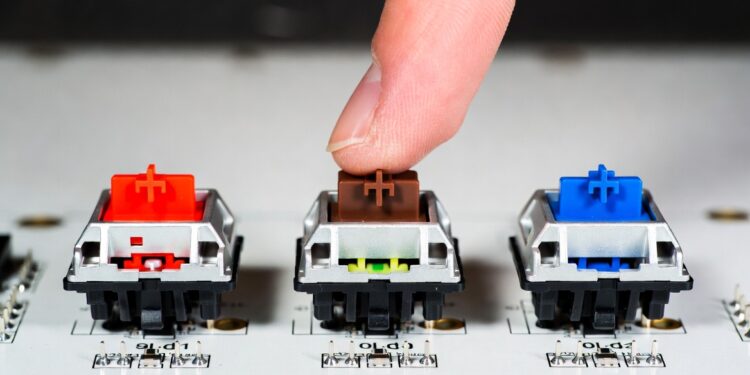
Switch technology is the heart of the experience. Membrane keyboards use a single rubber dome per key that collapses to complete a circuit. They are inexpensive, quiet, and thin but offer limited tactile feedback and shorter lifespans (typically 5–10 million actuations). Mechanical switches, by contrast, use individual spring-loaded mechanisms. Three primary behaviors dominate professional use:
- Linear (e.g., Cherry MX Red or Gateron Yellow equivalents): Smooth travel with no tactile bump. Favored for rapid, repetitive input such as coding, gaming-adjacent workflows, or high-volume data entry.
- Tactile (e.g., Cherry MX Brown or similar): A noticeable bump partway through the keystroke that signals actuation without an audible click. Excellent balance for writing, editing, and general productivity where accuracy matters.
- Clicky (e.g., Cherry MX Blue or Kailh Box White): Both tactile bump and loud click. Satisfying for many typists but often too noisy for shared or open-plan offices.
Keycaps and stabilizers affect both feel and longevity. Double-shot PBT keycaps resist the oily shine that develops on cheaper ABS plastic after months of use. Stabilizers on larger keys (spacebar, shift, enter) determine whether those keys feel solid or wobbly; good factories tune or lube them at the source.
Layout and form factor influence desk real estate and portability. Full-size boards include a number pad; tenkeyless (TKL) and 75% or 65% compact layouts save space and encourage better mouse positioning. Split or columnar-staggered ergonomic designs separate the hands and often angle or tent the halves to reduce ulnar deviation.
Connectivity and firmware round out the modern feature set. Dual-mode wireless (Bluetooth + proprietary 2.4 GHz dongle) has become standard on mid-to-high-end boards, delivering latency low enough for most professional work. Open-source firmware such as QMK or VIA enables deep customization: layers, macros, and even per-key RGB or haptic feedback on supported models. Hot-swap sockets let users replace switches without desoldering, dramatically extending the useful life of the board.
Benefits and Advantages
A well-chosen keyboard can measurably improve daily output and reduce hidden costs. Ergonomic research consistently shows that split and negatively inclined designs lower wrist extension and ulnar deviation. One multi-year study found significantly lower incidence of new musculoskeletal symptoms among users of fixed-split ergonomic keyboards compared with conventional flat designs, with no productivity penalty once users adapted.
Mechanical keyboards frequently deliver higher typing satisfaction and perceived accuracy. The distinct actuation point and feedback reduce “bottoming out” force over time, which can lower finger fatigue during long sessions. For programmers and heavy spreadsheet users, programmable layers and macros eliminate repetitive keystroke sequences, reclaiming minutes per hour that compound across a workweek.
Durability also matters for total cost of ownership. A quality mechanical board with PBT keycaps and an aluminum case can remain serviceable for five to seven years of heavy daily use, whereas budget membrane keyboards often show keycap wear and inconsistent feel within two years. Organizations that track peripheral refresh cycles see clear advantages in moving select roles to higher-quality hardware.
Finally, the psychological benefit of enjoying the tool itself should not be dismissed. Professionals who report higher satisfaction with their primary input device tend to maintain better posture and take fewer micro-breaks driven by discomfort.
Risks, Limitations, and Potential Downsides
Premium keyboards are not universally superior. The most common complaint about mechanical and split designs is the learning curve. Users accustomed to a standard layout or membrane feel often experience a temporary drop in speed and an increase in errors while adapting to a new switch or split geometry. Most regain baseline performance within one to three weeks, but the transition period can frustrate deadline-driven work.
Noise remains a practical constraint. Clicky switches or even loud tactile switches can disturb colleagues in open offices or during video calls. Linear or silent tactile options mitigate this but sacrifice some of the feedback many users seek.
Wireless implementations introduce battery management overhead and, in enterprise settings, additional security considerations. While modern Bluetooth stacks are far more secure than early versions, some organizations still prefer wired or tightly controlled 2.4 GHz solutions for sensitive environments. Battery life on premium boards is typically measured in weeks rather than days, yet users must still remember to charge or swap batteries.
Cost is the most obvious barrier. A well-equipped hot-swappable mechanical keyboard with good wireless can easily exceed $150–$250, compared with $30–$60 for a competent office membrane model. For large-scale deployments, the delta must be justified by reduced injury claims, lower replacement frequency, or measurable productivity gains.
Over-customization is a subtler risk. Endless switch experimentation or macro rabbit holes can become a distraction rather than a productivity tool. The best outcomes come from deliberate, limited changes aligned with actual workflow pain points.
Comparison with Alternatives
| Category | Representative Models (2026) | Approx. Price Range | Best For | Ergonomics | Typing Feel | Durability & Features | Drawbacks |
|---|---|---|---|---|---|---|---|
| Budget Membrane / Office | Logitech Pebble Keys, basic full-size | $25–$60 | General admin, light use | Low | Soft, quiet | Low–Medium; basic wireless options | Short lifespan, limited feedback |
| Premium Low-Profile | Logitech MX Keys S | $100–$130 | Multi-device professionals | Medium | Scissor, consistent | High build; excellent battery & flow | Less tactile; harder to mod |
| Value Mechanical (75%/TKL) | Keychron V3 Max / V5 Max | $80–$110 | Programmers, writers, hybrid use | Medium | Choice of switches | Hot-swap, wireless, VIA/QMK, PBT caps | Learning curve on compact layouts |
| Ergonomic Split | Logitech Wave Keys / Ergo K860, Epomaker Split65 | $100–$180 | Users with wrist/neck discomfort | High | Varies by switch | Good wireless; some hot-swap options | Larger footprint; adaptation time |
| Premium / Custom Ergonomic | Kinesis Advantage360, Bastard KB models | $250–$400+ | RSI recovery or power users | Very High | Highly tunable | Open-source firmware, tenting, trackball options | High cost; steepest learning curve |
The table illustrates clear segmentation. Most professionals will find the strongest value in the middle two rows: a solid mechanical board from Keychron or equivalent for primary work, paired with a low-profile travel board if needed. Organizations managing mixed workforces often standardize on one or two models with strong return policies and support ecosystems.
Key Considerations Before Using/Adopting
Individual buyers should first clarify primary tasks and any existing discomfort. Coders who value speed may lean linear or light tactile; editors and analysts often prefer distinct tactile feedback. Hand size and shoulder width influence whether a full-size, compact, or split layout feels natural.
Desk constraints and posture setup are equally important. A split keyboard on a shallow desk can force awkward reaching; tenting kits or negative-tilt stands help many users achieve neutral wrist angles. Monitor height and chair adjustment should be addressed alongside keyboard choice.
For enterprise or team purchases, additional factors apply: volume pricing and warranty support, IT security policies around wireless peripherals, provisioning simplicity (shared profiles or easy onboarding), and sustainability credentials (repairability, recyclable materials). Pilot programs with a small cohort of users who log comfort and output metrics provide stronger justification than top-down mandates.
Return windows and community resources matter more than marketing claims. Brands with active user forums, detailed documentation, and responsive support reduce the risk of a costly mismatch.
Real-World Use Cases or Case Studies
A mid-sized software firm rolled out Keychron V-series boards to its engineering team after several developers reported wrist fatigue. After a six-week adaptation period tracked via self-reported comfort scores and git commit volume, average daily active coding time increased modestly while reported end-of-day hand discomfort dropped sharply. The company has since made the boards a standard option in new-hire equipment packages.
A freelance investigative journalist with early RSI symptoms switched to a split ergonomic mechanical keyboard with tenting. Within a month she extended comfortable writing sessions from four to six-plus hours and reduced ibuprofen use. She now travels with a compact low-profile backup but keeps the split board as her primary workstation.
An accounting team evaluated both premium membrane and entry mechanical options for bulk purchase. After side-by-side testing, the group selected a hot-swappable mechanical model in the $90 range. Two years later, replacement rates remain far below historical membrane keyboard churn, and several team members have customized switch weights to personal preference without additional cost to the company.
Best Practices or How to Use it Effectively
Position the keyboard so elbows remain near 90 degrees and wrists stay in a neutral (straight) alignment. Consider a slight negative tilt or tenting if shoulders round forward. Pair the keyboard with an appropriately sized mouse or trackball and maintain the 20-20-20 eye-break habit.
When adopting a new layout or switch type, resist the urge to push through pain. Short, frequent practice sessions with deliberate focus on relaxed shoulders and light keystrokes accelerate adaptation. Most users benefit from temporarily lowering daily output targets during the first 7–14 days.
Maintain the board with periodic keycap removal and gentle cleaning. For mechanical switches, avoid eating over the keyboard; crumbs accelerate wear on stabilizers. If switches begin to feel inconsistent, hot-swap replacements are inexpensive and straightforward on supported boards.
Leverage firmware tools. Even basic macro layers for common email signatures, code snippets, or spreadsheet navigation repay the small initial time investment many times over. Keep changes conservative; over-complex layers become harder to remember than they are worth.
Finally, treat the keyboard as part of a larger ergonomic system. Monitor arm height, chair lumbar support, and foot position all interact with keyboard placement. Small adjustments across the workstation often yield larger comfort gains than any single peripheral upgrade.
Conclusion
The search for the “best” computer keyboard ultimately leads to a more nuanced question: best for whom, doing what, and under what constraints? In 2026 the market offers genuine options across nearly every combination of budget, form factor, and feature set. Mechanical and ergonomic designs demonstrably reduce fatigue and injury risk for many heavy users while delivering typing experiences that many professionals describe as genuinely enjoyable. Yet a well-made low-profile or even basic membrane keyboard remains perfectly adequate for lighter workloads and can represent smarter economics when scaled across large teams.
The highest-ROI decision is rarely the most expensive board; it is the one that matches your biomechanics, workflow patterns, and environment closely enough that you will use it comfortably for years. Take the time to understand switch feel, test layouts where possible, and factor in long-term health and replacement costs. When chosen thoughtfully, a quality keyboard becomes one of the highest-leverage productivity tools on the desk quiet, reliable infrastructure that supports sustained focus rather than demanding attention.
FAQs
What does “kibard” mean?
It is a frequent misspelling or autocorrect variant of “keyboard.” People searching the term are almost always looking for information or recommendations about computer keyboards.
Mechanical or membrane — which is better for professional work?
Mechanical keyboards generally offer superior feedback, durability, and customization, making them preferable for users who type heavily. High-quality membrane or scissor-switch boards (such as the Logitech MX Keys series) remain excellent for lighter use, travel, or environments where silence and low profile are priorities.
How long does it take to adapt to a split ergonomic keyboard?
Most users regain or exceed prior typing speed within one to three weeks. Initial awkwardness is common; consistent short practice sessions and attention to posture speed the transition.
Are wireless keyboards secure enough for corporate use?
Modern dual-mode boards with up-to-date firmware are generally acceptable for most business environments. Organizations with strict security requirements should evaluate specific models, prefer devices with dedicated dongles over Bluetooth-only, and follow standard endpoint management practices.
What switch type should programmers choose?
Many developers prefer linear or light tactile switches for speed during long coding sessions. Those who value confirmation of each keystroke often choose medium tactile switches. Clicky switches are usually avoided in shared offices.
Do ergonomic keyboards actually reduce RSI risk?
Multiple studies indicate they can lower the incidence and severity of musculoskeletal symptoms when paired with proper workstation setup. They are not a guaranteed cure but form a meaningful part of a comprehensive ergonomics strategy.
How much should I budget for a good professional keyboard?
For most knowledge workers, $80–$150 delivers excellent long-term value. Higher investments ($200+) make sense for users with existing discomfort or those who will heavily customize and keep the board for many years.
Can I try switches before buying?
Many vendors and keyboard meetup communities offer switch testers. Reputable online retailers also provide reasonable return windows. Trying a few switches in person dramatically reduces the chance of buyer’s remorse.