


In today’s digital economy, professionals and entrepreneurs are constantly bombarded with promises of effortless income. Social media ads featuring bold claims like “push a few buttons and make $24,197.84” have directed significant traffic to pbmethd.com, a site promoting what it calls the “Push Button” system. These ads tap into a very real desire among busy Americans for scalable side income or automated business models without the traditional grind.
This article provides a clear-eyed, evidence-based examination of pbmethd.com. We analyze its marketed features, the user journey it creates, safety and legitimacy signals, and practical considerations for business professionals evaluating similar opportunities in 2026. Our goal is to help decision-makers separate marketing hype from operational reality so they can protect both their finances and their time.
Key Takeaways
- pbmethd.com markets a low-cost ($67 range) digital product called “Push Button” through long-form video sales letters and aggressive Facebook advertising, promising automated or near-effortless income.
- Independent trust analysis platforms assign the domain very low scores (as low as 9.4/100), citing high risk factors, a newly registered domain (November 2024), and opaque ownership protected by privacy services.
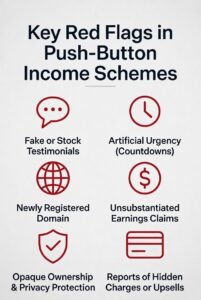
- The marketing funnel relies heavily on psychological tactics including countdown timers, questionable testimonials, and unsubstantiated earnings claims—patterns frequently flagged in make-money-online exposés.
- While some purchasers may receive basic digital training materials on e-commerce or affiliate concepts, independent reviews and user reports consistently question the value delivered relative to the hype and note risks of additional charges.
- For U.S. business professionals, the primary risks include financial loss, data privacy exposure, opportunity cost, and engagement with marketing practices that may conflict with FTC guidelines on earnings claims and testimonials.
- Sustainable income generation almost always requires substantive skill development, consistent execution, and realistic timelines—elements the “push button” framing actively downplays.
- Rigorous due diligence (domain age checks, multi-source reviews, realistic outcome assessment) remains the most reliable filter before engaging with any similar online opportunity.
Background: What Is Pbmethd Com?
pbmethd.com operates as a sales and delivery platform for a digital product branded as “Push Button.” Public analyses describe it as part of a recognizable category of online marketing funnels that use social media advertising to drive traffic to long video presentations promising extraordinary financial results with minimal ongoing effort.
The domain itself is relatively new. WHOIS records show creation on November 30, 2024, with ownership shielded behind a privacy service and an Iceland-based privacy provider. This combination of recent registration and hidden ownership is a common characteristic of higher-risk online offers. Trust scoring engines that aggregate dozens of technical and behavioral signals have rated the site poorly, with one prominent analyzer assigning a 9.4/100 trust score and highlighting elevated risks related to phishing, spam, and overall legitimacy concerns.
The core offering promoted through pbmethd.com is not a traditional SaaS platform or enterprise tool. Instead, it functions as an entry-point digital product—typically positioned as training, software access, or an automated “system”—sold at a one-time price point commonly seen in this niche ($67, sometimes presented with exit-intent discounts). The marketing narrative centers on simplicity: users allegedly follow “one step” or “push a few buttons” to generate substantial returns, often framed around affiliate marketing, e-commerce automation, or similar models.
It is important to note that the live site experience can vary. Some visitors report limited or placeholder content outside of active advertising campaigns, suggesting the platform functions primarily as a conversion-focused funnel rather than a persistent public resource. This opacity makes independent verification of exact deliverables challenging and increases reliance on secondary reporting from reviewers who have documented the ad-to-checkout flow.
For business professionals, context matters. The broader “make money online” and automation-tool market contains both legitimate skill-building resources and offerings that rely more on aspirational marketing than proven, replicable results. pbmethd.com sits within this crowded and often confusing landscape.
How It Works: Core Components and User Journey
The typical experience begins with targeted social media advertising, particularly on Facebook and Instagram. These ads use strong emotional hooks images of financial freedom, testimonials, and urgency language to drive clicks to pbmethd.com.
Once on the site, users encounter a lengthy video sales letter (often approaching or exceeding one hour). The video typically features:
- Multiple testimonial clips (frequently questioned by independent reviewers as inauthentic or sourced from stock/Fiverr talent).
- Dramatic earnings screenshots or claims.
- An automated countdown timer designed to create scarcity and pressure.
- A narrative that positions the “Push Button” method as a proprietary or simplified breakthrough.
After the video, the page funnels visitors toward a checkout process. The listed price is commonly $67, though dynamic pricing or one-time-offer upsells may appear. The checkout form requests standard billing and personal information. Reports from reviewers note that terms-and-conditions checkboxes have sometimes appeared pre-selected, a practice that raises compliance questions.
Post-purchase, buyers reportedly receive access to a members area containing digital materials—guides, videos, or basic software/tools related to online business tactics. Some similar funnels in this category have been documented transitioning users into higher-ticket upsells or requiring additional deposits (for example, trading accounts or advanced coaching). Public reporting on pbmethd.com specifically includes anecdotal mentions of follow-on charges beyond the initial fee.
Core components of the marketed system appear to include:
- A “method” or framework (specifics remain high-level in public descriptions).
- Templates or automation elements (often generic rather than highly customized).
- Community or support access (quality and responsiveness vary according to user reports on comparable products).
The entire model depends on high-volume advertising and conversion psychology more than transparent, verifiable product differentiation. This structure is common in the direct-response digital product space but becomes problematic when earnings claims lack substantiation or when post-sale experiences diverge significantly from pre-sale promises.
Benefits and Advantages (Claimed vs. Realistic Assessment)
Marketers behind offerings like the one on pbmethd.com emphasize several potential upsides:
- Low financial barrier to entry: At approximately $67, the price is accessible compared with high-ticket coaching programs that can run into thousands of dollars.
- Time efficiency narrative: The “push button” framing suggests users can bypass years of trial-and-error.
- Accessibility for beginners: Materials are positioned as suitable for people with little prior experience in online business.
- Scalability potential: If the underlying tactics (affiliate marketing, store building, or automation) have merit, users could theoretically apply them across multiple ventures.
These claimed advantages are not inherently implausible in the abstract. Well-designed digital training on legitimate e-commerce or performance marketing fundamentals can accelerate learning curves for motivated individuals. The low price point also reduces downside risk compared with expensive mentorships.
However, a balanced analysis must weigh these against execution realities. Independent examinations of similar funnels consistently find that the delivered content is often basic, publicly available elsewhere for free or low cost, or insufficient on its own to produce the dramatic outcomes advertised. The “automation” or “push button” element frequently requires ongoing work, technical setup, paid advertising spend, or market-specific knowledge that the marketing de-emphasizes.
For busy professionals, the real advantage of any educational product lies in actionable, up-to-date frameworks delivered efficiently. When marketing significantly overstates ease and understates required effort or capital, the net benefit turns negative due to time lost pursuing unrealistic paths.
Risks, Limitations, and Potential Downsides
The risk profile of pbmethd.com is the area where available evidence raises the most serious questions.
Multiple independent evaluators have flagged the domain as high-risk. The combination of very recent registration, privacy-protected ownership, and low trust scores creates a profile inconsistent with established, transparent vendors.
Marketing practices documented in exposés include:
- Use of testimonials whose authenticity has been questioned.
- Artificial urgency mechanisms (countdown timers).
- Earnings claims that appear difficult to substantiate at scale for typical users.
- Post-purchase experiences that, according to patterns in this niche, sometimes involve additional charges or limited recourse.
Financial risks extend beyond the initial $67. Users have reported unexpected subsequent charges in similar funnels, and disputing transactions can consume significant time even when successful. Data privacy is another consideration: entering payment and personal details on a low-transparency site carries inherent exposure.
Opportunity cost is perhaps the most understated risk for professionals. Time spent investigating, purchasing, accessing, and attempting to implement underperforming systems cannot be recovered. In a competitive business environment, that time has high value.
Regulatory context adds another layer. The FTC has clear rules regarding earnings claims, testimonials, and negative-option billing. Offers that rely heavily on atypical or unsubstantiated results while using high-pressure tactics operate in a gray area that has drawn enforcement attention in the broader industry.
None of this means every purchaser will experience problems. Some may receive basic materials that provide marginal value. The issue is one of expectation versus reality and the difficulty of assessing that gap before committing resources.
Comparison with Alternatives
Professionals evaluating online income or automation tools have many options. The following table highlights key differences between the profile of pbmethd.com / Push Button and more established alternatives.
Comparison Table
| Evaluation Criteria | pbmethd.com / Push Button | Legitimate Alternatives (e.g., accredited courses, established platforms) |
|---|---|---|
| Domain & Ownership Transparency | New domain (Nov 2024), privacy-protected ownership | Established domains, public business registration or clear entity info |
| Independent Trust Signals | Very low scores (e.g., ~9/100 on major analyzers) | Higher scores, verified purchaser reviews, third-party validations |
| Earnings & Outcome Claims | Heavy reliance on dramatic, often unsubstantiated figures | Usually none or accompanied by realistic averages and disclaimers |
| Marketing Approach | Long VSLs, urgency timers, questioned testimonials | Educational content, case studies, no high-pressure countdowns |
| Deliverables & Support | Basic digital materials; support quality inconsistent | Structured curricula, updates, community access, instructor interaction |
| Refund & Recourse | Policies exist but enforcement reports vary | Clear, published policies with straightforward processes |
| Long-term Skill Development | Limited according to reviewer assessments | Designed for progressive mastery and real-world application |
| Total Cost of Ownership | Initial fee + potential hidden/upsell costs + time | Transparent pricing; predictable ongoing investment |
Legitimate paths for professionals include structured courses on platforms with strong reputations, books and programs from proven practitioners, or direct investment in skills such as paid advertising management, content systems, or product development. These alternatives generally trade higher transparency and support for less “magic button” marketing.
Key Considerations Before Using or Adopting
Before engaging with pbmethd.com or any similar offering, professionals should apply a structured evaluation framework:
- Domain and business verification — Check creation date and ownership transparency using public WHOIS tools. New domains with hidden ownership warrant extra scrutiny.
- Multi-source independent research — Search the exact product name plus “review,” “scam,” or “complaint.” Cross-reference Scam-Detector, Reddit communities focused on scams, Trustpilot, and the Better Business Bureau.
- Testimonial validation — Perform reverse image searches on any prominent testimonials. Authentic results are often sparse or inconsistent with the marketing narrative.
- Full cost and commitment mapping — Identify not just the advertised price but potential upsells, required ad spend, time investment, and ongoing maintenance.
- Realistic outcome modeling — Ask what success would actually require. If the marketing suggests near-zero effort, treat that claim with strong skepticism.
- Payment protection — Use credit cards or virtual card services that allow easy disputes. Avoid methods with limited recourse.
- Alignment with professional context — Consider whether the time and mental energy would be better allocated to proven skill development or core business activities.
These steps do not guarantee perfect outcomes but substantially reduce the probability of costly missteps.
Real-World Use Cases and Case Studies
Publicly documented positive, independently verified case studies specifically tied to pbmethd.com are scarce. Most available information comes from reviewers who analyzed the advertising funnel and checkout process without completing a purchase, or from users reporting on similar or identical marketing patterns.
Common themes in reporting include:
- Initial curiosity driven by polished ads.
- Disappointment with the depth or originality of delivered materials.
- Frustration with post-purchase support or unexpected additional charges.
- Recognition that meaningful results required substantially more work and investment than advertised.
In contrast, professionals who achieve sustainable online income typically document journeys involving consistent content creation, paid traffic testing, product iteration, and relationship building—activities that align more closely with traditional business fundamentals than with “push button” narratives.
For organizations, pbmethd.com serves as a useful cautionary example when evaluating vendors or educational partners. Low transparency, aggressive conversion tactics, and weak independent validation are reliable indicators to proceed with extreme caution or decline engagement.
Best Practices: How to Use Similar Tools Effectively (or Decide Against Them)
If you encounter comparable offers, apply these practices:
- Implement a mandatory cooling-off period — Never purchase during the first exposure to urgency-driven marketing. Sleep on it and research the next day.
- Build a personal due-diligence checklist and use it consistently.
- Prioritize skill-based education over “done-for-you” systems when your goal is long-term capability.
- Allocate small test budgets only after thorough vetting, and track actual ROI including time.
- Document everything — Save ads, screenshots of claims, terms, and communications. This protects you if issues arise.
- Focus on value creation — The most reliable path to income involves solving real problems for paying customers, not consuming endless opportunity products.
- Leverage reputable intermediaries — When possible, purchase through well-known platforms (established marketplaces, accredited course providers) that offer buyer protections and transparent review systems.
Conclusion
pbmethd.com illustrates both the persistent appeal and the persistent pitfalls of “push button” income marketing in 2026. The platform uses familiar direct-response techniques to promote a low-priced digital product, yet multiple independent signals—domain age, trust scores, ownership opacity, and documented marketing patterns—converge on a high-risk profile.
For U.S. business professionals and entrepreneurs, the decision framework is straightforward: extraordinary claims require extraordinary evidence. When that evidence is missing or contradicted by available data, the rational choice is to redirect time and capital toward transparent, skill-building alternatives that have demonstrated value across many users over time.
The promise of effortless wealth through a single button remains, for the overwhelming majority of people, a marketing story rather than an operational reality. Prudent professionals protect their resources by treating such offers with disciplined skepticism and focusing instead on the fundamentals that actually move the needle in business and personal finance.
FAQs
What exactly does pbmethd.com sell?
It promotes a digital product called “Push Button,” positioned as a simplified system or training for generating online income. Public details on exact deliverables are limited because the site functions primarily as a sales funnel.
Is pbmethd.com safe or a scam?
Independent trust analyzers rate it as high-risk with very low trust scores. While not every user will experience direct harm, the combination of red flags makes it advisable to avoid for most people.
How much does it cost and are there hidden fees?
The advertised price is typically around $67. Reports on similar funnels indicate potential for additional charges or upsells after the initial transaction. Always review the full terms and monitor statements closely.
What are the biggest red flags?
Newly registered domain with hidden ownership, dramatic unsubstantiated earnings claims, questioned testimonials, urgency tactics, and limited independent positive verification.
Can the average person realistically make significant money with this?
Marketing suggests yes with minimal effort. Available evidence and patterns in this category suggest results are far more modest (or nonexistent) for most users and usually require substantial additional work and investment not highlighted in ads.
How does pbmethd.com compare to legitimate online business training?
Legitimate programs generally offer greater transparency, clearer deliverables, better support structures, and realistic expectations. They also tend to have stronger independent reputations and review profiles.
What should I do if I already purchased?
Document all communications and materials received. Review the refund policy immediately and initiate a return if within the window. Monitor credit card statements for unexpected charges and dispute any unauthorized ones. Consider reporting concerns to the FTC if you believe deceptive practices occurred.
Are there regulatory warnings about this type of offer?
The FTC actively monitors earnings claims and testimonial usage across the make-money-online space. While no specific enforcement action against pbmethd.com is referenced in current public sources, the marketing patterns used fall into categories that have drawn scrutiny in the past.