


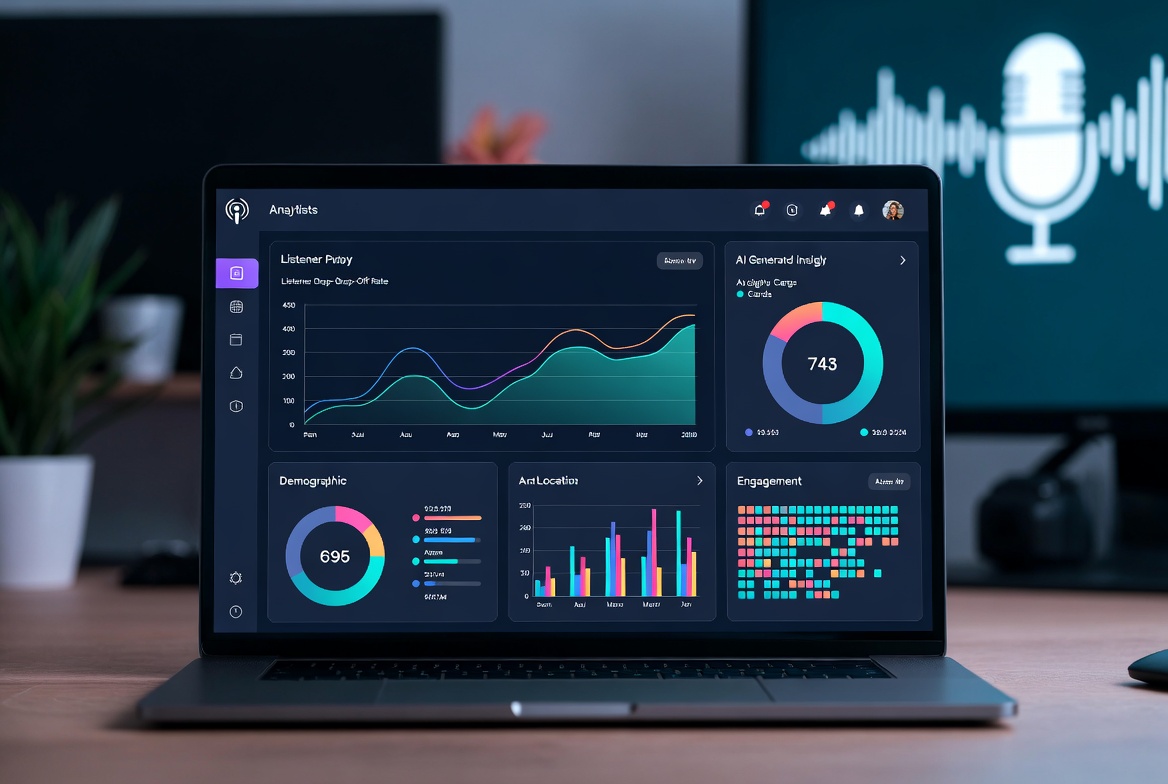
The US podcast industry has matured into a serious media business. What began as a niche medium for hobbyists and independent voices now commands projected revenues climbing from roughly $30 billion in 2025 toward $81 billion by 2031, according to industry forecasts. Yet many creators and media teams still rely heavily on vanity metrics primarily download numbers that reveal little about actual listener behavior, attention, or commercial value.
BackToFrontShow (often abbreviated BTFS) positions itself as a premium podcast analytics and audience intelligence platform designed to close that gap. It promises granular behavioral data, demographic and firmographic segmentation, AI-driven sentiment analysis, and predictive modeling that standard platform tools from Apple, Spotify, or most hosting providers do not deliver at the same depth.
This article provides a balanced, analytical examination of BackToFrontShow for US-based professional creators, podcast networks, digital agencies, and brand-side media teams. We explore what the platform actually does, how it integrates into existing workflows, its claimed benefits, the real limitations and costs, how it stacks up against alternatives, and the key questions decision-makers should answer before committing to a tool that starts at approximately $1,200 per month.
Key Takeaways
- BackToFrontShow functions as an enterprise-grade data intelligence layer that sits beneath a podcast’s RSS feed, delivering behavioral insights especially episode drop-off patterns, engagement signals, and AI sentiment analysis far beyond basic download counts.
- Pricing ($1,200/month Basic; ~$3,600/month Pro; custom Enterprise) targets established creators and teams already generating meaningful sponsorship or advertising revenue rather than hobbyist or early-stage shows.
- Integration via an analytics prefix on the RSS feed is relatively non-disruptive and works across most major hosting providers and distribution platforms without requiring migration.
- The platform’s strongest value lies in improving content strategy (retention, topic selection, episode structure) and strengthening advertiser conversations with credible audience data—users have reported up to 20% lifts in engagement in platform-cited feedback.
- High monthly costs and the need for sufficient audience scale create a meaningful barrier; ROI is clearest for professional operations with clear monetization paths and internal capacity to act on advanced insights.
- It excels at demographic/firmographic segmentation and predictive AI features but may be less specialized in pure ad attribution compared with tools focused narrowly on campaign measurement.
- Adoption requires deliberate goal-setting, cross-functional processes, and realistic expectations about data accuracy and implementation effort—analytics alone do not create growth.
What is BackToFrontShow?
BackToFrontShow is a podcast analytics and audience intelligence platform that emphasizes behavioral and qualitative insights over vanity metrics. In a 2026 media landscape where attention is fragmented and advertisers increasingly demand proof of engagement rather than raw reach, the platform aims to give creators and media businesses a “research team in the background.”
Unlike basic dashboards from Apple Podcasts Connect or Spotify for Podcasters—which primarily surface aggregate downloads, top episodes, and limited demographics—BackToFrontShow maps listener behavior across the entire distribution ecosystem. It tracks where listeners drop off within episodes, how long they stay on average, demographic and geographic segmentation, engagement patterns, and even AI-analyzed sentiment signals from listening behavior.
The platform positions itself for professional users: independent creators scaling toward sustainable businesses, podcast networks, digital marketing agencies managing multiple shows, and B2B or media brands that treat podcasts as a strategic channel. Its value proposition centers on turning raw listener data into editorial intelligence—helping teams decide not just what performed well, but why certain segments disengage and how to adjust content, length, format, or promotional strategy accordingly.
Industry context matters here. As the US podcast market grows more competitive and sponsorship rates become more scrutinized, the difference between a 45% and 70% completion rate on a key episode can directly influence CPM negotiations and renewal discussions. BackToFrontShow seeks to make that distinction visible and actionable.
How it Works
BackToFrontShow operates as a data intelligence layer that integrates with a show’s existing RSS feed through an analytics prefix. This approach allows the platform to collect and process listener data across platforms and geographies without forcing creators to change hosting providers or rebuild distribution.
Once integrated, the system aggregates behavioral signals: precise drop-off points within episodes, average listening duration, completion rates by segment, and cross-platform attention metrics. It layers on demographic and firmographic data where available, enabling segmentation by age, location, inferred interests, or even corporate affiliation signals in B2B contexts.
A distinguishing element is the AI component. The platform applies sentiment analysis and pattern recognition to surface automated recommendations—such as suggested episode lengths, topic clusters likely to retain specific demographics, or optimal windows for ad placement based on attention curves. Predictive modeling features aim to forecast audience growth scenarios under different content strategies.
Core components include:
- Behavioral drop-off and retention analytics — granular, episode-level views of where and why listeners leave.
- Demographic and engagement intelligence — audience composition and interaction depth beyond surface-level geography.
- AI-driven insights engine — content recommendations, predictive growth modeling, and smarter ad-trigger suggestions.
- Cross-platform and international coverage — data spanning major directories and more than 15 countries, relevant for US shows with global audiences.
- Reporting and segmentation tools — customizable views for editorial teams, sponsor reporting, or agency client deliverables.
The technical lift is intentionally designed to be manageable. Most users report that adding the analytics prefix is straightforward for common hosts, preserving existing workflows while unlocking the deeper dataset.
Benefits and Advantages
For professional US podcast operations, the primary advantages cluster around strategic clarity and commercial leverage.
First, behavioral data enables more precise content decisions. Knowing that a specific audience segment consistently drops off at the 12-minute mark during ad reads—or that certain topic introductions lose 35–40% of listeners—gives editorial teams concrete signals for experimentation. Creators can test stronger hooks, tighter pacing, chapter markers, or format changes and measure impact quickly.
Second, the platform strengthens monetization conversations. Advertisers and sponsors increasingly ask for evidence of attention and audience quality, not just download estimates. Demographic segmentation and engagement curves provide credible, defensible numbers for rate cards, custom packages, and performance reporting. Agencies managing client podcasts particularly value centralized, presentation-ready data.
Third, AI-assisted features can accelerate insight generation. Automated recommendations and predictive modeling reduce the manual analysis burden, allowing smaller teams to punch above their weight in strategy development.
Additional benefits include international listener insights (useful for US shows expanding globally) and the ability to benchmark episodes or shows against each other internally. Platform-reported user feedback has included a 95% satisfaction rate among active users and claims of approximately 20% engagement improvements when insights are actively applied—figures that should be viewed as directional rather than guaranteed, given the absence of large-scale independent longitudinal studies at the time of writing.
Risks, Limitations, and Potential Downsides
No premium analytics platform is without trade-offs, and BackToFrontShow’s positioning creates several important considerations.
Cost is the most immediate barrier. At roughly $1,200 per month for the Basic tier and around $3,600 for Pro—with Enterprise negotiated higher—the platform represents a meaningful ongoing investment. For a solo creator or small independent show generating modest sponsorship revenue, this expense can quickly outweigh returns unless audience scale and monetization are already robust. The tool is explicitly not designed for hobbyists or shows still building consistent listenership.
A related limitation is the minimum viable scale required for meaningful ROI. Behavioral insights deliver the greatest value when there is sufficient data volume to identify reliable patterns. Shows with very low or highly variable downloads may find the outputs noisy or less actionable.
Implementation and interpretation require effort. While integration is relatively light, extracting maximum value demands someone on the team who can translate data into editorial or commercial actions. Smaller operations without dedicated analytics or strategy resources may underutilize the platform.
Data privacy and compliance add another layer. Listener data collection across borders triggers considerations under US state privacy laws (such as CCPA/CPRA) and international regulations. Teams should evaluate how the platform handles consent signals, data retention, and deletion requests.
Finally, public independent case studies and long-term ROI documentation remain relatively limited compared with more established tools. Much of the available positive feedback originates from platform-cited or aggregated user sentiment rather than peer-reviewed or audited performance data. Decision-makers should treat performance claims as plausible but requiring internal validation.
Comparison with Alternatives
Choosing the right analytics approach depends on team size, monetization model, technical comfort, and specific questions the organization needs answered.
Comparison of Podcast Analytics Options (2026)
| Platform/Tool | Behavioral Drop-off & Retention Depth | Demographic & AI Insights | Ad Attribution Strength | Integration Ease | Pricing (approx.) | Best Suited For |
|---|---|---|---|---|---|---|
| BackToFrontShow | High (core strength) | High (AI + segmentation) | Moderate | High (RSS prefix) | $1,200–$3,600+/mo | Professional creators, networks, agencies scaling monetization |
| Spotify for Podcasters | Moderate | Moderate | High (within ecosystem) | Very High | Free | Shows with heavy Spotify listenership |
| Apple Podcasts Connect | Low–Moderate | Limited | Low | High | Free | Apple-centric audiences |
| Podtrac | Low–Moderate | Moderate | High (verification) | Moderate | Subscription-based | Ad verification and multi-platform measurement |
| Host-provided (Transistor, Buzzsprout, etc.) | Moderate–High (varies) | Basic | Basic | Very High | Included or low-cost | Indie creators prioritizing simplicity |
| Specialized alternatives (e.g., Backtracks) | High | Moderate–High | High | Moderate | Varies | Deep technical measurement needs |
BackToFrontShow differentiates most clearly on behavioral depth and AI-augmented editorial intelligence. It is less specialized in pure campaign attribution than some ad-focused tools. Many professional operations use it alongside native platform dashboards and lighter host analytics rather than as a complete replacement.
Key Considerations Before Using or Adopting
Before signing up, US media professionals and decision-makers should work through a structured evaluation:
- Revenue and scale assessment — Calculate current or projected sponsorship/advertising revenue. Does the potential lift in rates, retention, or new deals justify $1,200–$3,600+ monthly? Many users find the math works only once consistent five-figure or higher monthly revenue is in view.
- Clear objective definition — Are you primarily trying to improve content retention, justify higher CPMs, optimize ad placement, or support multi-show portfolio decisions? Different goals favor different tool strengths.
- Technical and workflow fit — Confirm your RSS host supports the required prefix or custom feed elements without friction. Map who will own data review and action planning.
- Internal capability — Does the team have (or can it develop) the analytical literacy to turn insights into experiments and decisions? The most sophisticated dashboard delivers little value if insights sit unused.
- Privacy and compliance review — Involve legal or compliance stakeholders early, especially for shows with international listeners or B2B audiences.
- Opportunity cost — Compare the investment against alternatives: hiring a part-time producer or strategist, investing in better production, or running paid promotion experiments.
- Trial and validation plan — If a meaningful trial period is available, define success metrics in advance (e.g., specific retention improvements or sponsor feedback quality) rather than relying on general platform claims.
Real-World Use Cases and Applications
While large-scale public case studies remain emerging, the platform’s design aligns with several common professional scenarios:
- B2B or professional-services podcasts — A network targeting executives can use firmographic and behavioral signals to refine episode formats that better hold attention among time-constrained listeners, then present audience quality data to attract premium SaaS or consulting sponsors.
- Independent creator scaling sponsorships — A personal finance or career podcast with growing but plateauing downloads can identify which segments drop off during certain segments and adjust structure, leading to higher completion rates and stronger sponsor renewal conversations.
- Agency-managed portfolios — Digital agencies overseeing multiple client shows gain a unified view for reporting, enabling data-backed recommendations that differentiate their service and support higher retainers.
- Cross-platform expansion — US shows building international audiences can leverage geographic and demographic segmentation to prioritize distribution partnerships or localized promotional efforts.
In each case, the common thread is existing or near-term monetization pressure combined with sufficient audience volume for patterns to emerge.
Best Practices for Effective Use
To maximize value:
- Anchor usage to specific, measurable business outcomes rather than “better data” in the abstract.
- Establish a regular cadence (e.g., bi-weekly editorial data reviews) so insights influence planning before episodes are recorded.
- Combine platform outputs with qualitative signals—listener surveys, community feedback, or guest performance notes—for a fuller picture.
- Use segmentation aggressively for sponsor materials while being transparent about methodology and sample sizes.
- Treat the AI recommendations as hypotheses to test, not directives to follow blindly.
- Monitor leading indicators (retention curves, engagement by segment) alongside lagging ones (downloads, revenue).
- Revisit tool fit annually as the show’s scale, team, and monetization model evolve.
Conclusion
BackToFrontShow represents a meaningful evolution in how professional podcast operations can understand and act on audience behavior. By moving beyond download counts to granular retention, demographic intelligence, and AI-augmented recommendations, it offers a toolset aligned with the realities of a competitive, advertiser-supported US podcast market.
That said, the platform is not a universal solution. Its premium pricing and design assumptions make it most appropriate for established creators, networks, and agencies with clear paths to monetization and the internal discipline to translate data into decisions. For smaller or earlier-stage operations, the cost-benefit equation often favors simpler or free native tools until scale justifies the step up.
In the broader context of 2026 media strategy, the most successful podcast businesses will be those that develop genuine data literacy—regardless of which specific platform they choose. BackToFrontShow can accelerate that capability for the right organizations, but only when paired with realistic expectations, disciplined implementation, and ongoing evaluation of ROI. The decision ultimately comes down to whether the depth of behavioral insight is likely to move key business metrics enough to justify the investment at your current stage.
FAQs
What specific insights does BackToFrontShow provide that Apple or Spotify analytics do not?
It delivers episode-level behavioral drop-off curves, more detailed demographic and engagement segmentation, AI sentiment signals derived from listening patterns, and predictive modeling for content and growth scenarios. Native platform tools tend to emphasize aggregate downloads and basic demographics within their ecosystems.
Is BackToFrontShow appropriate for small or emerging podcasts?
Generally no. The pricing and data-volume requirements make it best suited for shows or portfolios already generating meaningful revenue or operating at professional scale. Hobbyists and early-stage creators are usually better served by free or low-cost host and platform tools until they reach consistent sponsorship traction.
How technical is the setup process?
Most users describe integration as straightforward—typically involving the addition of an analytics prefix to the RSS feed. It does not require changing hosting providers. Technical support from the platform and documentation help teams through the process.
What realistic ROI should users expect?
Outcomes vary widely. Some users report improved sponsor negotiations and measurable retention gains (platform-cited figures include around 20% engagement improvement in active cases). However, ROI depends heavily on existing audience scale, monetization model, and how effectively the team applies insights. There is no universal payback timeline.
Can BackToFrontShow replace Spotify for Podcasters or Apple Podcasts Connect?
It is best viewed as a complementary layer rather than a full replacement. Many professional teams continue using native dashboards for platform-specific visibility while layering BackToFrontShow for deeper behavioral and cross-platform intelligence.
Does it work with every podcast hosting provider?
Compatibility is broad because it leverages the RSS feed. Most major hosts support the necessary customizations. Prospective users should verify with their specific host during evaluation.
How does the platform handle listener privacy and data compliance?
As with any third-party analytics service, teams should review the provider’s privacy policy, data processing agreements, and retention practices. US-based operations should also consider state privacy regulations and any international listener implications.
Are there long-term contracts or additional hidden costs?
Pricing is presented as subscription-based with Enterprise tiers negotiated. Prospective users should request full contract terms, data limits, and any overage or add-on fees during the sales process to avoid surprises.